
ENDOMETRIAL HYPERPLASIA
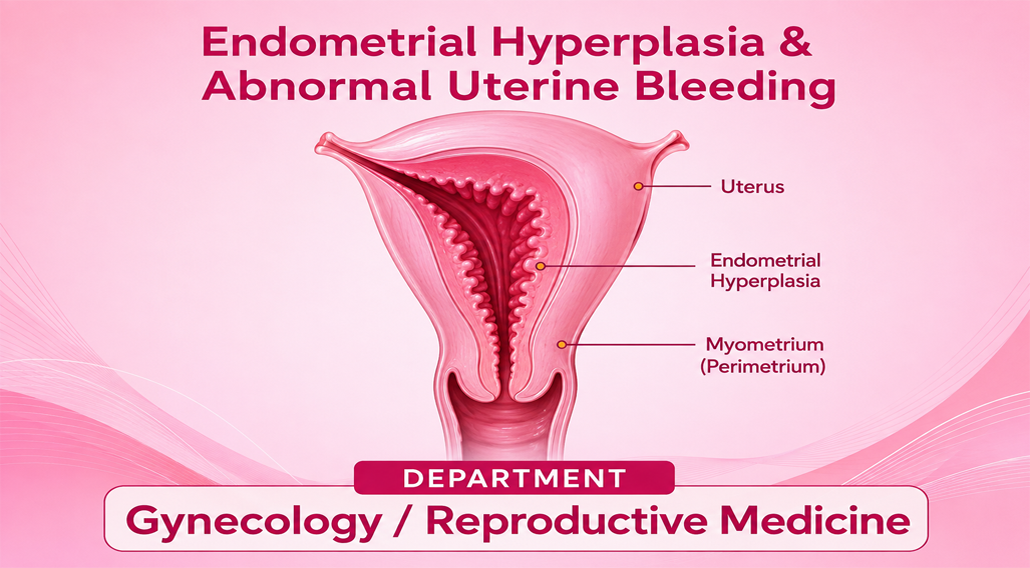
What are the signs and symptoms of endometrial hyperplasia?
The most common sign of endometrial hyperplasia is abnormal uterine bleeding. You should consult your obstetrician–gynecologist (OB-GYN) if you experience any of the following:
- Bleeding during your period that is heavier or lasts longer than usual.
- Menstrual cycles that are shorter than 21 days (counting from the first day of one period to the first day of the next).
- Any bleeding after menopause.
What tests may be done to diagnose abnormal bleeding?
- A transvaginal ultrasound may be performed to measure the thickness of the endometrium. During this test, a small ultrasound probe is placed inside the vagina.
- Sound waves from the probe create images of the pelvic organs. A thickened endometrium may suggest endometrial hyperplasia.
- The only way to confirm whether cancer is present is to examine a small sample of endometrial tissue under a microscope.
- Tissue samples can be obtained through:
- Endometrial biopsy
- Dilation and Curettage (D&C)
- Hysteroscopy
What is endometrial hyperplasia?
- Endometrial hyperplasia is a condition in which the endometrium (the lining of the uterus) becomes abnormally thick.
- Although it is not cancer, some types of endometrial hyperplasia can increase the risk of developing uterine (endometrial) cancer if left untreated.


Leave a Reply
Want to join the discussion?Feel free to contribute!